? What You Need to Know in a Nutshell
- Approximately 90% of total knee replacements function for 10 years, and 84% for 15 years; replacement may be necessary afterward.
- Aseptic loosening is the most common reason for prosthesis replacement; infection and instability are other major causes.
- In young, active, and overweight patients, the initial prosthesis may wear out sooner.
- Hip replacements typically last 15–20 years; the revision rate in the first 10 years is approximately 3–5%.
Does a prosthesis last a lifetime? This is one of the questions most frequently asked by patients undergoing hip replacement surgery. Artificial joints are quite durable, but they do not last forever. This is where revision joint replacement comes into play: it is the procedure to replace the original prosthesis that has worn out, become loose, or become infected.
What Is a Revision Knee Replacement?
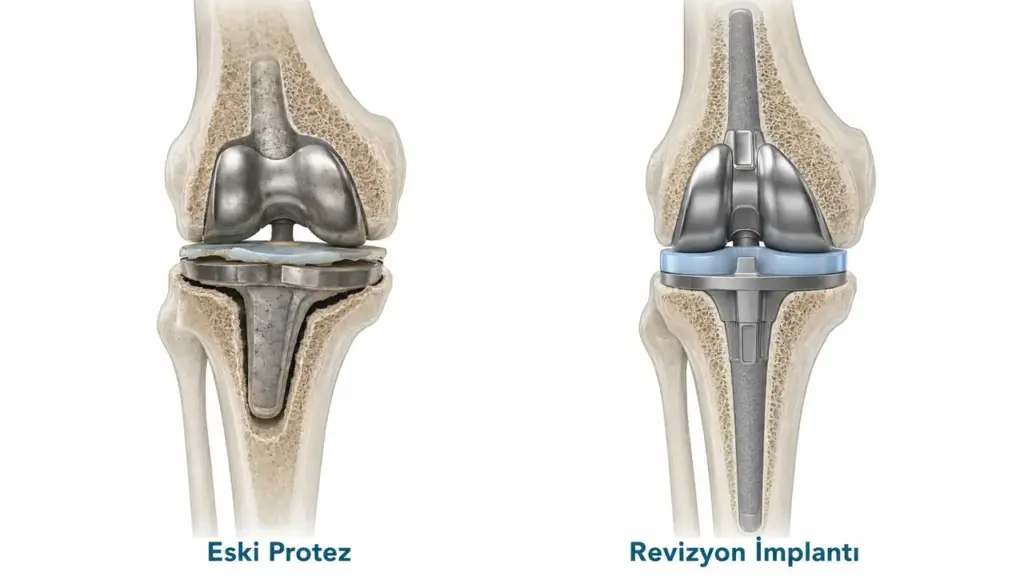
Revision arthroplasty is the surgical procedure to remove a previously implanted knee or hip prosthesis when it has lost its function and replace it with a new one. Unlike the initial (primary) prosthesis, it often requires repairing bone defects and the use of specially designed implants. In this respect, it is a more complex surgical procedure than the initial surgery.
Why Is an Initial Prosthesis Replaced?
Given enough time, every prosthesis may eventually require replacement. According to AAOS/OrthoInfo data, the primary reason for prosthesis replacement is the implant’s gradual separation from the bone over time. This process typically progresses slowly and is accompanied by pain.
The main conditions that shorten the lifespan of a prosthesis and necessitate replacement are as follows:
- Aseptic loosening: Microparticles formed by friction between joint surfaces trigger the body’s immune response and disrupt the implant’s attachment to the bone. This is the most common cause of revision.
- Infection: Bacteria that colonize the area around the joint can impair the prosthesis’s function. While the infection rate for primary knee replacements is approximately 1–2%, it rises to 3–6% in revision procedures.
- Instability: Weakening of the ligaments and tissues surrounding the joint can cause the prosthesis to become unstable.
- Wear and fracture: Wear of the plastic spacer, mechanical fracture of the implant, or fractures in the bone surrounding the prosthesis (periprosthetic fractures).
- Recurrent dislocations: Especially in hip replacements, if the joint repeatedly dislocates, revision surgery may be considered.
What Does This Mean for Patients?
The lifespan of a prosthesis varies significantly from patient to patient. According to the *Journal of Bone and Joint Surgery* and related registry studies, the survival rate for total knee replacements is approximately 91% at 10 years, 84% at 15 years, and 78% at 20 years. For hip replacements, the 10-year survival rate in elderly patients is over 90%.
The most significant factor affecting these rates is the patient profile. Younger and more active patients place greater and longer-term stress on the prosthesis, so they are more likely to require revision. Similarly, wear and loosening are more common in overweight individuals. In other words, how long a prosthesis will last depends not only on the quality of the implant but also on the patient’s age, activity level, and weight.
Listen to the Doctor: Clinical Observations
According to Prof. Dr. Hasan Göçer, when revision surgery is on the table, patients’ biggest concern is often the question, “Will the second surgery be more difficult than the first?” This concern is understandable, as revision surgery is technically much more complex.
Prof. Dr. Göçer emphasizes that in his clinical practice, a significant proportion of patients mistakenly attribute pain or mild instability to “the natural consequences of aging” and delay seeking treatment. However, when prosthesis loosening is detected early, it is possible to intervene before bone loss progresses. This both simplifies the surgery and positively impacts the outcome. Symptoms such as persistent pain, increasing instability, or a clicking sound while walking are warning signs that must be evaluated without delay.
How Does the Revision Process Work?
Revision prosthesis surgery is planned following a careful evaluation process. Generally, the steps proceed as follows:
- Evaluation and diagnosis: X-rays show the implant’s position and any potential loosening. If infection is suspected, blood tests (erythrocyte sedimentation rate, CRP) and joint fluid analysis are performed; bone scintigraphy or MRI may be added as needed.
- Planning: Depending on the degree of bone loss and ligament damage, it is determined whether a standard or a custom revision implant will be used.
- Removal of the old implant: The existing prosthesis is removed in a way that causes minimal damage to the surrounding bone.
- Bone reconstruction: Any resulting voids are filled with metal augments or bone grafts.
- Placement of the new prosthesis: Special implants with longer and thicker stems, which typically sit deep within the bone, are used; this provides extra support.
- Rehabilitation: The postoperative physical therapy process is critical for regaining movement and strength.
According to Prof. Dr. Hasan Göçer, one of the most critical steps in the success of revision surgery is determining whether an infection is present prior to surgery; because the treatment approaches for loosening due to infection and loosening due to wear are different. Interestingly, the survival rate of specialized implants used for revision is also quite encouraging: one study reported a 5-year survival rate of 92% for revision implants.
Common Misconceptions
There are some common misconceptions among patients regarding revision prostheses:
- “Once a prosthesis is implanted, there will be no problems for the rest of my life” — Prostheses are durable but have a limited lifespan; regular follow-up is important.
- “Pain is normal; it will go away” — Persistent or worsening pain may be a sign of loosening or infection; it should not be ignored.
- “Revision always means replacing the entire prosthesis” — In some cases, only a single component is replaced; the decision is based on the evaluation.
Conclusion
Revision knee and hip replacement is a surgical procedure aimed at restoring mobility and quality of life when the original prosthesis has worn out, become loose, or become infected. Recognizing symptoms early and undergoing regular follow-up make the process easier to manage.
References
Sources
- OrthoInfo (AAOS), “Revision Total Knee Replacement” — https://orthoinfo.aaos.org/en/treatment/revision-total-knee-replacement/
- Hospital for Special Surgery (HSS), “Knee Revision” — https://www.hss.edu/health-library/conditions-and-treatments/list/knee-revision
- NCBI/PMC, “How long does a knee replacement last? A systematic review and meta-analysis” — https://pmc.ncbi.nlm.nih.gov/articles/PMC6381229/