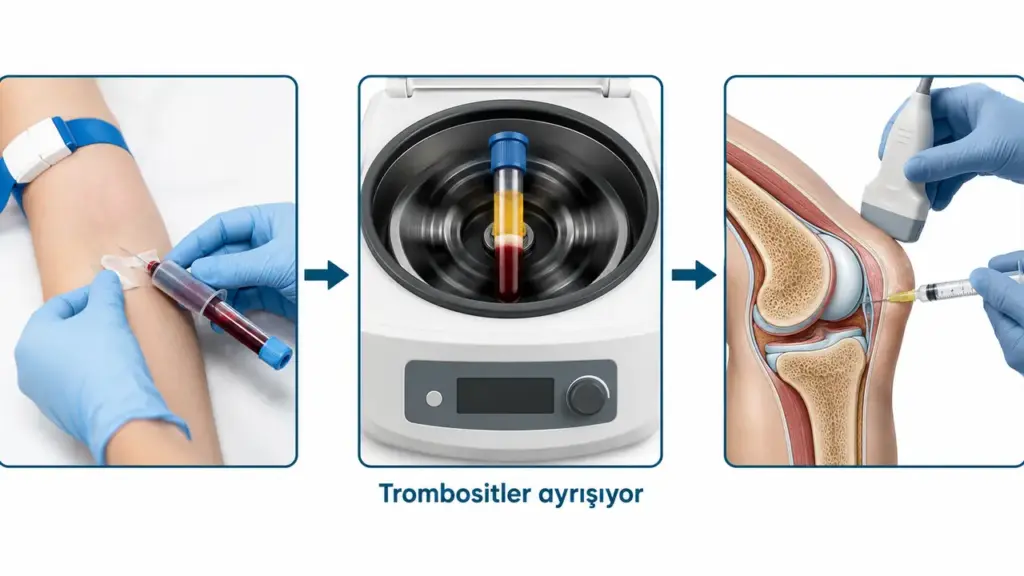
? Quick Facts from Prof. Dr. Göçer
- PRP (Platelet-Rich Plasma) is a mixture of growth factors derived from the patient’s own blood, with a platelet concentration increased by 5–8 times; the procedure is performed within at least 45 minutes.
- A 2021 Cochrane review found that PRP provides better pain control in the short term (6 months) compared to hyaluronic acid in knee osteoarthritis.
- CGF (Concentrated Growth Factors) is a second-generation platelet concentrate; the fibrin network in its structure releases growth factors over a longer period.
- These treatments are effective in early-to-mid-stage joint degeneration; however, their capacity for healing remains limited in cases of advanced cartilage loss.
“I don’t want to have surgery—are there any other options?” — It’s common to hear this statement repeatedly at an orthopedic clinic. In recent years, PRP and stem cell therapy have emerged as biological methods that offer alternatives to surgery for joint pain. However, understanding how these methods work, who they are suitable for, and what realistic expectations are—ensures both sound decision-making and helps prevent disappointment.
What Is PRP? How Does It Work?
PRP therapy (Platelet-Rich Plasma), is based on the injection of a mixture derived from the patient’s own blood—in which the platelet concentration has been increased through centrifugation—into the painful area. Platelets contain growth factors such as PDGF, TGF-β, and IGF-1; these factors stimulate tissue repair processes, suppress inflammation, and support the activity of cartilage cells (chondrocytes). Since the entire procedure is performed using the patient’s own biological material, the risk of an allergic reaction is very low.
What Is CGF? How Is It Different from PRP?
CGF (Concentrated Growth Factors) is defined as a second-generation platelet concentrate. The main difference lies in the preparation protocol: CGF is processed using a specialized centrifugation program with varying speeds; the resulting dense fibrin matrix releases growth factors in a more controlled and sustained manner. Some studies suggest that this slow-release property may offer additional benefits in terms of tissue regeneration; however, there is less long-term clinical data available on CGF compared to PRP.
According to Prof. Dr. Hasan Göçer, the choice between PRP and CGF does not have to be the same for every patient: “The condition of the joint, the patient’s overall health profile, and their expectations shape this decision. There is no standard protocol; a personalized assessment is essential.”
How Effective Are PRP and Stem Cell Therapy for Joint Pain?
According to a 2022 systematic review published in the Journal of the American Academy of Orthopaedic Surgeons (JAAOS), PRP injections for knee osteoarthritis result in significant improvements in pain and function scores during a 6–12-month follow-up period; however, the magnitude and duration of the effect vary significantly from patient to patient. While the effect is more pronounced in early-stage knee osteoarthritis (Kellgren-Lawrence Stages 1–2), the benefit remains limited in advanced stages.
However, non-surgical joint treatment options are not suitable for every patient. Active joint infection, coagulopathy, platelet count abnormalities, and certain autoimmune diseases may constitute contraindications.
The concept of “stem cells” is often misunderstood. The treatments administered in clinical settings are mostly bone marrow aspirate concentrates (BMAC) or adipose-derived stromal cell products. These products do not contain embryonic stem cells; the mesenchymal stromal cells they contain support tissue repair processes. Stem cell therapy is a field that has not yet been standardized; before deciding on treatment, patients should be provided with transparent information regarding which product will be administered and the level of available clinical evidence.However, non-surgical joint treatment options are not suitable for every patient. Active joint infection, coagulopathy, platelet count abnormalities, and certain autoimmune diseases may constitute contraindications.
“Content that presents PRP and CGF as ‘miracle injections’ creates unrealistic expectations in patients. These treatments are valuable biological tools; however, they do not have the capacity to ‘rewind’ nature in cases of advanced cartilage loss. When administered to the right patient, for the right indication, and using the correct technique, they can provide meaningful benefits. In my practice, I always evaluate the patient’s radiological findings alongside their functional status before recommending this treatment.”
Prof. Dr. Hasan Göçer — Orthopedic and Traumatology SpecialistHow Long Does PRP Therapy Last, and How Many Sessions Are Required?
Although protocols vary from center to center, the most common approach for knee osteoarthritis consists of 3 injections administered 3–4 weeks apart. Mayo Clinic guidelines indicate that the onset of effects typically becomes noticeable after 4–6 weeks and that recovery can take up to 6 months. Some clinicians prefer a single-session approach; however, the optimal protocol has not yet been definitively standardized. Therefore, it is important to develop an individualized plan with your orthopedic specialist.
Frequently Asked Questions
Is a PRP injection painful?
Although local anesthesia is not used during the procedure, most patients describe the injection as mild pressure or a momentary twinge. Ultrasound-guided injections are more precise and therefore more comfortable. A mild increase in soreness or tightness may be felt for 1–2 days following the procedure; this is an expected response.
Is PRP treatment permanent?
The effects of PRP are not permanent and vary from person to person. Clinical studies generally report effectiveness lasting between 6 and 12 months. In some patients, this duration may be longer, while in others it may be shorter than expected. Due to the progressive nature of the underlying joint damage, repeat injections may be necessary over time.
Are PRP and CGF the same thing?
No. Both are derived from the patient’s own blood and contain growth factors; however, the preparation protocols differ. CGF is processed at gradually increasing centrifuge speeds and forms a denser fibrin matrix. This difference affects the rate and duration of growth factor release. Clinically, it has not yet been clearly demonstrated which is superior.
When can I return to sports after PRP treatment?
It is recommended to restrict high-intensity exercise and sports for at least 1–2 weeks. Light activities, such as walking, can generally be resumed within a few days. The exact timeline depends on the joint treated and the patient’s individual healing process; it is important to follow your orthopedic specialist’s guidance.
Can anyone undergo PRP treatment?
No. Active infections, platelet disorders, use of anticoagulant medications, and certain chronic diseases may constitute contraindications. Therefore, a detailed medical history must be taken and, if necessary, laboratory tests must be performed before treatment. The eligibility assessment must be conducted by a physician.
References
- National Cancer Institute (NCI), “Bone Cancer Treatment (PDQ®)” — https://www.cancer.gov/types/bone/patient/bone-treatment-pdq
- Grimer R, et al., “Surgical options for children with osteosarcoma,” The Lancet Oncology, 2005; data updated and presented by the American Cancer Society — https://www.cancer.org/cancer/types/bone-cancer.html
- Groundland JS, Binitie O, “Reconstruction After Tumor Resection in the Growing Child,” Orthopedic Clinics of North America, 2016; abstract: StatPearls, NCBI — https://www.ncbi.nlm.nih.gov/pmc/articles/PMC4764103/