The diagnosis of a meniscus tear is made by evaluating the physical examination and imaging results together.
- Physical examination: The tear is investigated using specific tests performed on the knee (e.g., rotation tests).
- Medical history: The mechanism of injury and the course of symptoms are evaluated.
- X-ray: It does not directly show the meniscus; however, it rules out accompanying bone problems.
- MRI: This is the most valuable method for diagnosing a meniscus tear; it shows the location and type of the tear.
MRI helps determine whether the tear is located in the vascular (red) region or the avascular (white) region. This distinction directly affects the likelihood of spontaneous healing and the choice of treatment.
Non-Surgical Treatment of Meniscus Tears
Non-surgical treatment of meniscus tearsis the preferred approach, particularly for degenerative, small tears in the vascularized region. The goal is to reduce pain, alleviate swelling, and restore function by strengthening the muscles around the knee.
- Rest and activity management: Avoid twisting and squatting movements that strain the knee.
- Ice and swelling control: To reduce pain and swelling in the early stages.
- Physical therapy: Exercises that strengthen the muscles around the knee and maintain range of motion.
- Medication: Anti-inflammatory pain relievers as needed (as recommended by a doctor).
- Injections: Treatments such as PRP may be considered for some patients.
In cases of degenerative tears and small tears, recovery with conservative treatment generally occurs within 6–8 weeks. Some tears in the blood-supplied area may heal within 4–6 weeks. The process varies depending on the type of tear and the patient’s compliance.
Clinical Assessment by Prof. Dr. Hasan Göçer
“In my clinical practice, I specifically emphasize that not every meniscus tear requires surgery. Especially in age-related degenerative tears, the majority of patients recover without surgery through an appropriate physical therapy program. I reserve surgery for cases involving mechanical symptoms such as locking or those that do not respond to conservative treatment.”
Prof. Dr. Hasan Göçer — Orthopedic and Traumatology Specialist
This approach is of great importance because unnecessary meniscus surgery can increase the risk of osteoarthritis in the long term. For this reason, non-surgical treatment is tried first, especially in degenerative tears. Surgery, however, is planned in cases with clear indications to preserve knee health.
Meniscus Tear Surgery
Meniscus tear surgery is performed for tears that do not respond to conservative treatment, cause locking, or are suitable for repair. The procedure is typically performed using an arthroscopic (minimally invasive) technique through small incisions. There are two main options:
- Meniscus repair (suturing): If the tear is in a well-vascularized area and is suitable, the meniscus is sutured to preserve it. Preserving the meniscus is important for long-term knee health.
- Partial meniscectomy: For tears that are not suitable for repair, only the damaged portion is removed; healthy tissue is preserved as much as possible.
When repair is possible, preserving the meniscus provides better long-term protection for the knee joint against osteoarthritis. However, not every tear is suitable for repair; the decision may become clear during surgery, depending on the tear’s location, type, and the condition of the tissue.
Things People with Meniscus Tears Should Avoid
To support the healing process and prevent the tear from getting larger, it is important to avoid certain movements:
- Avoid sudden twisting and twisting movements that strain the knee.
- Avoid deep squats and sitting on your knees.
- Do not persist with activities that cause pain.
- Do not remain in static or strenuous positions for long periods.
- Do not resume strenuous exercise or sports without a doctor’s recommendation.
These precautions help protect the knee both during non-surgical treatment and during post-surgical recovery. A return to activity should be gradual and based on the recommendations of your doctor and physical therapist.
From Evaluation to Recovery: How Does the Process Proceed?
| Stage | Time | What Happens? |
|---|---|---|
| Initial Examination | Day 1 | Medical history and knee examination are performed; imaging is ordered if necessary |
| MRI Evaluation | Week 1 | The location, type, and grade of the tear are determined |
| Treatment Decision | Weeks 1–2 | It is determined whether conservative or surgical treatment is necessary |
| Treatment | Depending on the situation | Physical therapy or arthroscopic surgery is performed |
| Recovery & Return | Weeks | A gradual return to daily activities and sports is made |
Initial Examination and MRI: The location, type, and grade of the tear are determined through a knee examination and MRI; these findings form the basis for the treatment decision.
Treatment Decision and Implementation: Depending on the tear, either conservative treatment or arthroscopic surgery is selected. For degenerative tears, non-surgical methods are prioritized.
Recovery and Return to Activity: Muscle strength and range of motion are regained through physical therapy; the return to activity is gradual and controlled.
Frequently Asked Questions
What causes a meniscus tear?
Meniscus tears occur for two main reasons: in young people and athletes, due to trauma such as a sudden twisting of the knee; in older adults, due to wear and tear (degenerative changes). Sudden sprains and repetitive strain are risk factors.
Does a meniscus tear heal on its own?
This depends on the location of the tear. Small, stable tears in the well-vascularized outer part of the meniscus (the red zone) may heal on their own. However, tears in the non-vascularized inner part (white zone) have a low chance of healing on their own.
Can a meniscus tear heal without surgery?
Many meniscus tears, especially degenerative and small ones, can heal with non-surgical treatment. Physical therapy, rest, and medication when necessary are part of this process. Healing typically takes 6–8 weeks. However, surgery may be necessary in cases of mechanical symptoms such as locking.
How long does it take for a meniscus tear to heal?
With conservative treatment, recovery from degenerative and small tears usually takes 6–8 weeks; some tears in the blood-supplied area may heal in 4–6 weeks. Recovery may take longer if the tear is repaired surgically. The duration varies depending on the type of tear and the treatment.
What helps with a meniscus tear in the knee?
Exercises that strengthen the muscles around the knee, rest, ice application, and activity modification can aid in recovery. It is important to avoid twisting motions and deep squats that strain the knee. These measures should be tailored based on the recommendations of a doctor and physical therapist.
How long does meniscus tear surgery take?
Arthroscopic meniscus surgeries are generally short and usually take about an hour to complete. The duration may vary depending on the type of tear and whether repair or debridement is performed. The exact duration is determined based on the surgical plan.
Outcome
A meniscus tear is damage to the cartilage that acts as a cushion in the knee, and not every tear requires surgery. The location, type, and severity of the tear determine the course of treatment; while non-surgical treatment is sufficient for most patients with degenerative or small tears, arthroscopic surgery is considered for tears that cause locking or are suitable for repair. Preserving the meniscus as much as possible is important for long-term knee health.
You can begin the examination process to assess your specific situation regarding a meniscus tear. Prof. Dr. Hasan Göçer evaluates each patient’s clinical presentation individually to determine the appropriate treatment options.
Sources
- Hospital for Special Surgery (HSS), “Meniscus Tear: Symptoms & Treatment,” 2025 — https://www.hss.edu/health-library/conditions-and-treatments/list/meniscus-tear
- Mayo Clinic, “Torn meniscus — Diagnosis & treatment”, 2022 — https://www.mayoclinic.org/diseases-conditions/torn-meniscus/…
- NCBI/PMC, “Meniscal pathology — the evidence for treatment”, 2014 — https://www.ncbi.nlm.nih.gov/pmc/articles/PMC4060175/
🦴 Quick Facts from Prof. Dr. Göçer
- A meniscus tear is damage to the C-shaped cartilage in the knee joint that acts as a cushion.
- Not every tear requires surgery; tears in the well-vascularized outer portion of the meniscus (the red zone) may heal on their own.
- In cases of degenerative and small tears, recovery with conservative treatment typically takes 6–8 weeks.
- Mechanical symptoms such as locking or catching, or certain types of tears—such as a bucket-handle tear—may require surgery.
A sudden twist of the knee or age-related wear and tear leads to one of the most common knee problems. A meniscus tear is damage to the cartilage structure (meniscus) in the knee joint that acts as a cushion and stabilizer between the femur and tibia. The type, location, and cause of the tear determine the course of treatment.
What Is a Meniscus Tear?
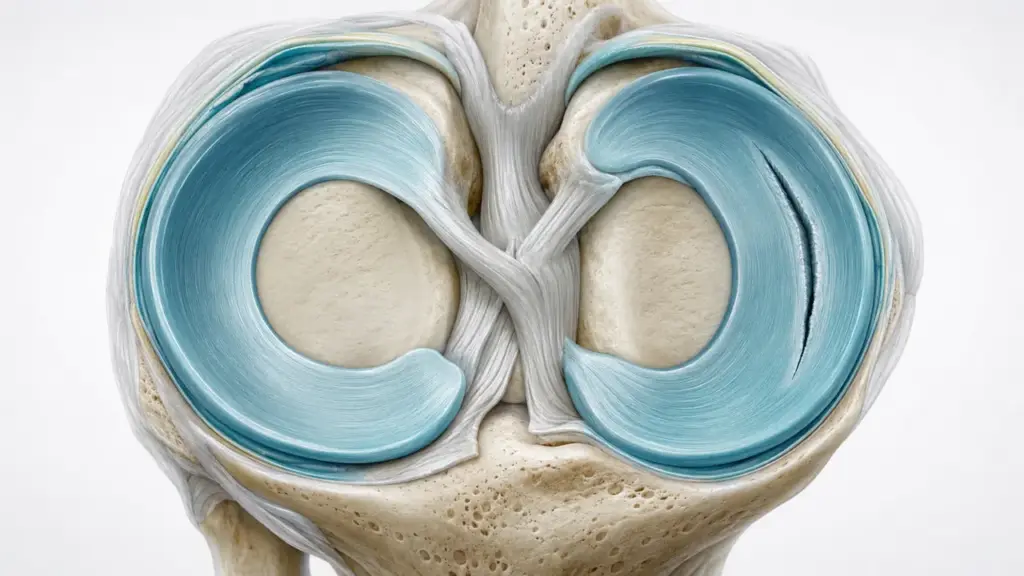
The meniscus is a C-shaped cartilage structure found on both sides of the knee joint (medial and lateral). It distributes weight, absorbs shock, and provides stability to the knee. A meniscus tear is partial or complete damage to this structure.
Tears occur for two main reasons: in young people and athletes, due to traumatic causes such as a sudden twisting of the knee; in older adults, due to wear and tear (degenerative changes). Since the outer third of the meniscus is well-vascularized (red zone), tears in this area can heal, whereas tears in the non-vascularized inner portion (white zone) have a low chance of healing on their own.
Symptoms of a Meniscus Tear
Symptoms vary depending on the type and size of the tear. While some small tears cause only mild discomfort, others significantly restrict knee movement. The main symptoms of a meniscus tear are as follows:
- Knee pain: Pain that worsens especially when squatting, twisting, or using stairs.
- Swelling: Swelling that develops within hours or days after the injury.
- Catching and locking: A sensation of the knee “locking” at a certain angle or catching.
- Limited range of motion: Difficulty fully bending or straightening the knee.
- Feeling of instability: A sensation that the knee is not stable.
According to Prof. Dr. Hasan Göçer, mechanical symptoms such as knee locking or noticeable catching are an important clue regarding the type of tear; such symptoms may indicate tears that do not respond to conservative treatment and may require surgical evaluation.
Meniscus Tear Grades
Meniscus tears are graded based on their severity as seen on MRI. This grading guides treatment decisions.
| Grade | Meaning | General Approach |
|---|---|---|
| Grade 1 | Mild signal change within the meniscus | Usually conservative |
| Grade 2 | More pronounced damage, but not reaching the surface | Mostly conservative |
| Grade 3 degree | Actual tear reaching the meniscus surface | Conservative or surgical treatment depending on the case |
Grade 1 and 2 findings often reflect wear and tear rather than an actual tear and are managed with non-surgical methods. Grade 3, however, indicates an actual tear reaching the meniscus surface; the decision on treatment is based on the location and type of the tear, as well as the patient’s symptoms.
How Is a Meniscus Tear Diagnosed?
The diagnosis of a meniscus tear is made by evaluating the physical examination and imaging results together.
- Physical examination: The tear is investigated using specific tests performed on the knee (e.g., rotation tests).
- Medical history: The mechanism of injury and the course of symptoms are evaluated.
- X-ray: It does not directly show the meniscus; however, it rules out accompanying bone problems.
- MRI: This is the most valuable method for diagnosing a meniscus tear; it shows the location and type of the tear.
MRI helps determine whether the tear is located in the vascular (red) region or the avascular (white) region. This distinction directly affects the likelihood of spontaneous healing and the choice of treatment.
Non-Surgical Treatment of Meniscus Tears
Non-surgical treatment of meniscus tearsis the preferred approach, particularly for degenerative, small tears in the vascularized region. The goal is to reduce pain, alleviate swelling, and restore function by strengthening the muscles around the knee.
- Rest and activity management: Avoid twisting and squatting movements that strain the knee.
- Ice and swelling control: To reduce pain and swelling in the early stages.
- Physical therapy: Exercises that strengthen the muscles around the knee and maintain range of motion.
- Medication: Anti-inflammatory pain relievers as needed (as recommended by a doctor).
- Injections: Treatments such as PRP may be considered for some patients.
In cases of degenerative tears and small tears, recovery with conservative treatment generally occurs within 6–8 weeks. Some tears in the blood-supplied area may heal within 4–6 weeks. The process varies depending on the type of tear and the patient’s compliance.
Clinical Assessment by Prof. Dr. Hasan Göçer
“In my clinical practice, I specifically emphasize that not every meniscus tear requires surgery. Especially in age-related degenerative tears, the majority of patients recover without surgery through an appropriate physical therapy program. I reserve surgery for cases involving mechanical symptoms such as locking or those that do not respond to conservative treatment.”
Prof. Dr. Hasan Göçer — Orthopedic and Traumatology Specialist
This approach is of great importance because unnecessary meniscus surgery can increase the risk of osteoarthritis in the long term. For this reason, non-surgical treatment is tried first, especially in degenerative tears. Surgery, however, is planned in cases with clear indications to preserve knee health.
Meniscus Tear Surgery
Meniscus tear surgery is performed for tears that do not respond to conservative treatment, cause locking, or are suitable for repair. The procedure is typically performed using an arthroscopic (minimally invasive) technique through small incisions. There are two main options:
- Meniscus repair (suturing): If the tear is in a well-vascularized area and is suitable, the meniscus is sutured to preserve it. Preserving the meniscus is important for long-term knee health.
- Partial meniscectomy: For tears that are not suitable for repair, only the damaged portion is removed; healthy tissue is preserved as much as possible.
When repair is possible, preserving the meniscus provides better long-term protection for the knee joint against osteoarthritis. However, not every tear is suitable for repair; the decision may become clear during surgery, depending on the tear’s location, type, and the condition of the tissue.
Things People with Meniscus Tears Should Avoid
To support the healing process and prevent the tear from getting larger, it is important to avoid certain movements:
- Avoid sudden twisting and twisting movements that strain the knee.
- Avoid deep squats and sitting on your knees.
- Do not persist with activities that cause pain.
- Do not remain in static or strenuous positions for long periods.
- Do not resume strenuous exercise or sports without a doctor’s recommendation.
These precautions help protect the knee both during non-surgical treatment and during post-surgical recovery. A return to activity should be gradual and based on the recommendations of your doctor and physical therapist.
From Evaluation to Recovery: How Does the Process Proceed?
| Stage | Time | What Happens? |
|---|---|---|
| Initial Examination | Day 1 | Medical history and knee examination are performed; imaging is ordered if necessary |
| MRI Evaluation | Week 1 | The location, type, and grade of the tear are determined |
| Treatment Decision | Weeks 1–2 | It is determined whether conservative or surgical treatment is necessary |
| Treatment | Depending on the situation | Physical therapy or arthroscopic surgery is performed |
| Recovery & Return | Weeks | A gradual return to daily activities and sports is made |
Initial Examination and MRI: The location, type, and grade of the tear are determined through a knee examination and MRI; these findings form the basis for the treatment decision.
Treatment Decision and Implementation: Depending on the tear, either conservative treatment or arthroscopic surgery is selected. For degenerative tears, non-surgical methods are prioritized.
Recovery and Return to Activity: Muscle strength and range of motion are regained through physical therapy; the return to activity is gradual and controlled.
Frequently Asked Questions
What causes a meniscus tear?
Meniscus tears occur for two main reasons: in young people and athletes, due to trauma such as a sudden twisting of the knee; in older adults, due to wear and tear (degenerative changes). Sudden sprains and repetitive strain are risk factors.
Does a meniscus tear heal on its own?
This depends on the location of the tear. Small, stable tears in the well-vascularized outer part of the meniscus (the red zone) may heal on their own. However, tears in the non-vascularized inner part (white zone) have a low chance of healing on their own.
Can a meniscus tear heal without surgery?
Many meniscus tears, especially degenerative and small ones, can heal with non-surgical treatment. Physical therapy, rest, and medication when necessary are part of this process. Healing typically takes 6–8 weeks. However, surgery may be necessary in cases of mechanical symptoms such as locking.
How long does it take for a meniscus tear to heal?
With conservative treatment, recovery from degenerative and small tears usually takes 6–8 weeks; some tears in the blood-supplied area may heal in 4–6 weeks. Recovery may take longer if the tear is repaired surgically. The duration varies depending on the type of tear and the treatment.
What helps with a meniscus tear in the knee?
Exercises that strengthen the muscles around the knee, rest, ice application, and activity modification can aid in recovery. It is important to avoid twisting motions and deep squats that strain the knee. These measures should be tailored based on the recommendations of a doctor and physical therapist.
How long does meniscus tear surgery take?
Arthroscopic meniscus surgeries are generally short and usually take about an hour to complete. The duration may vary depending on the type of tear and whether repair or debridement is performed. The exact duration is determined based on the surgical plan.
Outcome
A meniscus tear is damage to the cartilage that acts as a cushion in the knee, and not every tear requires surgery. The location, type, and severity of the tear determine the course of treatment; while non-surgical treatment is sufficient for most patients with degenerative or small tears, arthroscopic surgery is considered for tears that cause locking or are suitable for repair. Preserving the meniscus as much as possible is important for long-term knee health.
You can begin the examination process to assess your specific situation regarding a meniscus tear. Prof. Dr. Hasan Göçer evaluates each patient’s clinical presentation individually to determine the appropriate treatment options.
Sources
- Hospital for Special Surgery (HSS), “Meniscus Tear: Symptoms & Treatment,” 2025 — https://www.hss.edu/health-library/conditions-and-treatments/list/meniscus-tear
- Mayo Clinic, “Torn meniscus — Diagnosis & treatment”, 2022 — https://www.mayoclinic.org/diseases-conditions/torn-meniscus/…
- NCBI/PMC, “Meniscal pathology — the evidence for treatment”, 2014 — https://www.ncbi.nlm.nih.gov/pmc/articles/PMC4060175/