? Quick Facts from Prof. Dr. Göçer
- The radiological signs of knee osteoarthritis (gonarthrosis) may begin an average of 5–10 years before symptoms appear; early diagnosis expands treatment options.
- If pain continues to limit daily life despite 6 months of treatment with medication, exercise, and injections, the decision to undergo joint replacement surgery is considered.
- The 15–20-year implant survival rate for total knee replacement surgery is over 90% according to current data. (AAOS, 2023)
- More than 80,000 knee replacement surgeries are performed annually in Turkey, and this number has doubled over the past 10 years.
That familiar crunch in your knee when you get out of bed in the morning, the sharp pain that shoots through your leg as you walk down the stairs, or the stiffness that wakes you up at night… Knee osteoarthritis is a condition that many patients initially ignore, but which significantly affects their quality of life over time. So, when does this condition lead to the decision to get a knee replacement?
What Is Knee Osteoarthritis and How Does It Develop?
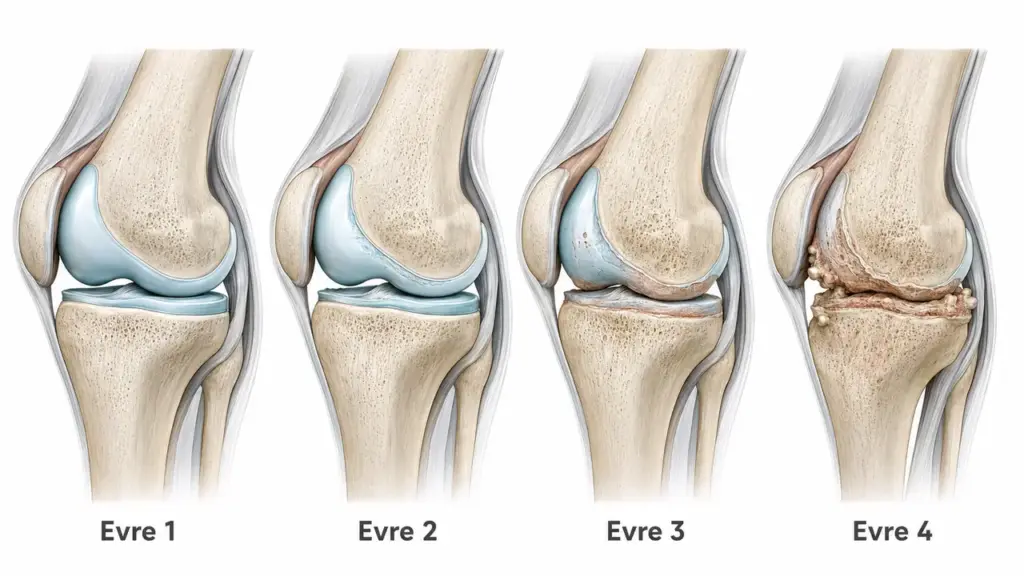
Knee osteoarthritis (gonarthrosis) is a degenerative joint disease caused by the gradual wear and tear of the cartilage covering the knee joint, leading to the exposure of the underlying bone. This process is a silent, gradual wear and tear that spans years: the cartilage thins, the joint space narrows, and the bone ends begin to rub against each other. While mild morning stiffness and brief episodes of pain are common in the early stages, the joint may become completely nonfunctional in advanced stages.
Early Signs of Knee Osteoarthritis: Overlooked Warning Signs
According to Prof. Dr. Hasan Göçer, the vast majority of patients do not visit the clinic for the first time with a complaint of pain, but rather with the complaint, “My knees sometimes swell, but it goes away.” These temporary swellings are an early sign of an inflammatory process beginning within the joint. The following symptoms should not be ignored:
- Morning stiffness: Joint stiffness lasting 15–30 minutes after getting out of bed
- Activity-related pain: Pain that occurs when going up or down stairs, walking for long periods, or squatting
- Crepitus: A crackling or grinding sound felt when bending or straightening the knee
- Swelling and increased warmth: Swelling observed in the knee, especially after an active day
- Changes in knee shape: When the legs begin to take on an “O” or “X” shape, this may be a sign of advanced knee osteoarthritis
Stages of Treatment for Knee Osteoarthritis: Non-Surgical Options First
Treatment for knee osteoarthritis is like a staircase: each step comes into play when the previous one proves insufficient. This step-by-step approach, widely accepted in orthopedic practice, can be summarized as follows:
| Stage | Estimated Duration | What Is Done? |
|---|---|---|
| 1. Diagnosis and Monitoring | Initial examination | X-ray, clinical evaluation; staging (Kellgren-Lawrence scale) |
| 2. Conservative Treatment | 3–6 months | Pain relievers, exercise program, weight management, physical therapy |
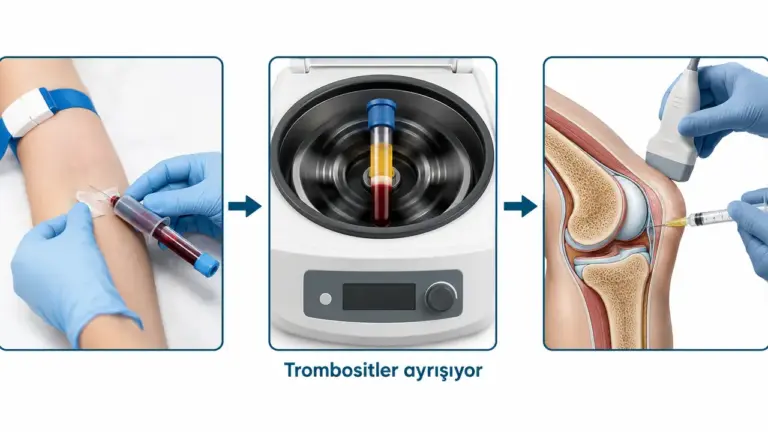
| 3. Injection Therapies | Effect lasts for weeks to months | Hyaluronic acid (viscosupplementation), PRP, or corticosteroid injection |
| 4. Joint-Preserving Surgery | Recovery 3–6 months | High tibial osteotomy — preferred for young patients with a single-site lesion |
| 5. Joint Replacement Surgery | Active rehabilitation for 3 months | Partial (unicondylar) or total knee replacement; if there is no response to conservative treatment |
Table notes: Stage 1 is the starting point for each process; the changes seen on an X-ray may not always correspond to the pain the patient feels. In Stage 2, the goal of medication is not only to relieve pain but also to protect the joint through muscle strengthening. The hyaluronic acid injection administered in Stage 3 supports joint lubrication; the duration of its effect varies from person to person. Stage 4 is generally intended for patients under 50 years of age whose inner or outer joint regions are more severely worn. Stage 5 is only considered when the previous stages prove insufficient.
When Is a Knee Replacement Necessary for Osteoarthritis? Decision Criteria
Prof. Dr. Göçer emphasizes that in his clinical practice, he bases the decision to perform knee replacement not solely on radiological findings, but on the impact on the patient’s daily life. If the following conditions are present together, knee replacement surgery may be considered:
- Pain persists despite at least 6 months of treatment with medication, exercise, and injections.
- Daily life is restricted: inability to walk more than 200–300 meters, waking up due to nighttime pain, and inability to perform basic household activities.
- Advanced joint narrowing (Kellgren-Lawrence Stages 3–4) is evident on X-ray.
- Severe joint deformity (varus/valgus deformity) has developed.
Important Note: Age alone is not a determining factor. A 55-year-old patient without severe symptoms is evaluated differently from a 70-year-old patient who is no longer able to move.
Partial or Total? How Is the Type of Prosthesis Determined?
A partial knee replacement (unicompartmental prosthesis) is performed when only the inner or outer compartment of the joint is worn; the ligaments are preserved, allowing for faster recovery. A total knee replacement, on the other hand, covers all surfaces of the joint and is more commonly used. The decision on which type of replacement to use is made by evaluating the distribution of cartilage damage, ligament integrity, and the patient’s overall condition together. This decision should be made in consultation with the patient after providing sufficient information.
“Deciding on a knee replacement isn’t about losing a race; it’s about helping the patient regain their quality of life. I ask my patients: ‘Is it pain that’s limiting you, or is it fear?’ Most of the time, the two are intertwined. Knowledge reduces fear; a decision made at the right time pays off for many years to come.”
Prof. Dr. Hasan Göçer — Orthopedic and Traumatology Specialist
Post-Surgery Process: How Long Does Recovery Take?
On the first day after surgery, patients begin getting out of bed and taking short walks; this early mobilization prevents blood clots and accelerates knee movement. According to AAOS data, the vast majority of patients are able to resume basic daily activities within 6 weeks and longer walks within 3 months. Full recovery and regaining strength typically occur within 6–12 months. Adherence to physical therapy and a home exercise program during this period directly impacts the outcome.
Knee replacement surgery may be followed by complications such as persistent pain, infection, or implant loosening; therefore, regular follow-up visits should not be neglected. It is recommended that you consult an orthopedic specialist if you have any questions.
Frequently Asked Questions
At what age does knee osteoarthritis typically begin?
Although gonarthrosis is generally more common in people over 50, it can also occur in people in their 40s—especially those who have suffered a knee injury, have engaged in heavy physical labor for a long time, or are overweight. Once diagnosed at an early age, the progression of the disease can be slowed through joint-preserving approaches.
What helps reduce pain in knee osteoarthritis?
In the short term, anti-inflammatory medications and cold/heat therapy can relieve pain. In the long term, weight loss, exercises that strengthen the quadriceps muscles, and physical therapy support the joint. Hyaluronic acid or PRP injections may provide significant relief for several months in some patients. You should consult a doctor to determine which method is right for you.
Up to what age can knee replacement surgery be performed?
There is no upper age limit; the determining factors are the patient’s overall health and tolerance for surgery. Successful knee replacement surgeries have been performed on patients in their 80s. Additional risk factors, such as cardiovascular or respiratory system diseases, are evaluated in consultation with the anesthesia team.
Does osteoarthritis go away without joint replacement surgery?
Osteoarthritis is not a reversible condition; lost cartilage does not regenerate on its own. However, the progression of the disease can be slowed, and symptoms can be kept under control for a long time. In advanced-stage knee osteoarthritis, surgical options are considered when pain and loss of function persist.
Which is better: a partial knee replacement or a total knee replacement?
Both options have appropriate indications; neither is absolutely superior to the other. A partial knee replacement is preferred when damage is limited to a single compartment and the ligaments are intact; it allows for faster recovery with less bone loss. A total knee replacement, on the other hand, provides more reliable long-term results in cases of widespread joint damage. The decision should be made in consultation with an orthopedic specialist based on the findings of the physical examination and imaging studies.
References
- American Academy of Orthopaedic Surgeons (AAOS/OrthoInfo), “Osteoarthritis of the Knee” — https://orthoinfo.aaos.org/en/diseases–conditions/osteoarthritis-of-the-knee/
- National Institute of Arthritis and Musculoskeletal and Skin Diseases (NIAMS/NIH), “Osteoarthritis” — https://www.niams.nih.gov/health-topics/osteoarthritis
- Lespasio MJ, et al., “Knee Osteoarthritis: A Primer,” The Permanente Journal, 2017 — https://www.ncbi.nlm.nih.gov/pmc/articles/PMC5638628/