? Quick Tips from Prof. Dr. Göçer
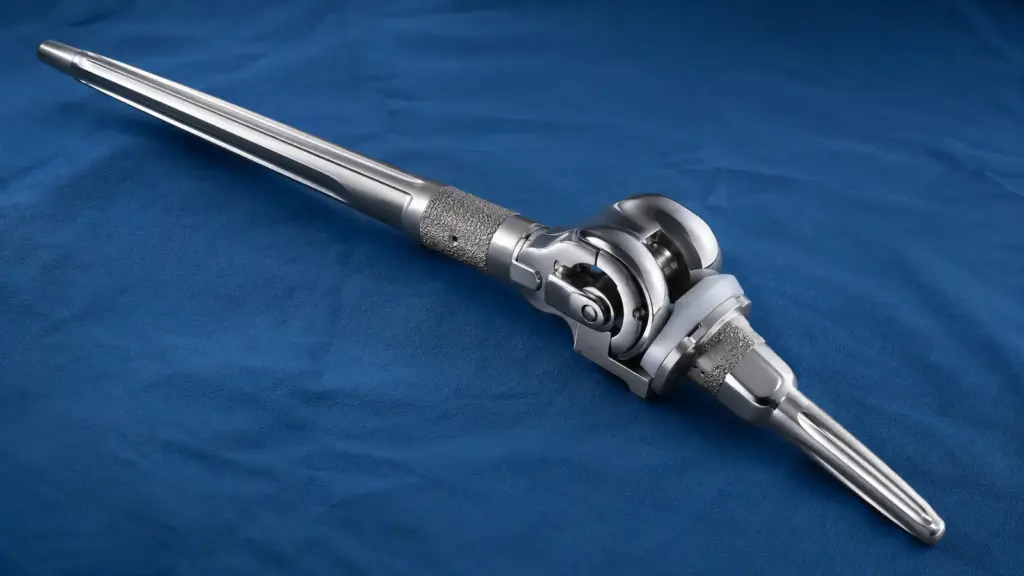
- A tumor prosthesis (mega prosthesis) is a modular, metal implant used to repair the large bone and joint cavity formed after a bone tumor has been excised with wide margins.
- Today, limb-sparing surgery can be performed in more than 90% of cases of extremity bone sarcomas.
- The 5-year overall survival rate in patients who received a mega prosthesis has been reported to average 78% across various series (analysis of 115 cases, 2024).
- Thanks to its modular design, the prosthesis is sized to fit the patient’s bone cavity during surgery and allows for early mobilization.
When a bone tumor is removed with wide margins, it leaves behind not just a small cavity, but often a loss that encompasses a large portion of the bone and the adjacent joint. A tumor prosthesis — also known colloquially as a mega prosthesis — is a specialized implant designed to repair this large defect and restore the limb’s function.
What Is a Tumor Prosthesis?
A tumor prosthesis is used to repair the large bone-joint defect (particularly malignant sarcomas and certain benign but aggressive tumors). Unlike a standard joint prosthesis, it can replace a long section of bone and the adjacent joint.
The term “mega prosthesis” also refers to the same implant; the term “mega” derives from the fact that the prosthesis covers a much larger bone segment than standard joint prostheses. These prostheses are most commonly used around the knee (lower end of the femur, upper end of the tibia) and in the hip region.
According to Prof. Dr. Hasan Göçer, the most significant advantage of the mega prosthesis is that it provides a stable, weight-bearing repair immediately after tumor removal, thereby enabling the patient to regain mobility early on and, if necessary, continue chemotherapy.
What Is Tumor Prosthesis Surgery?
Tumor prosthesis surgery consists of two main stages: the removal of the tumor with safe margins (resection) and the reconstruction of the resulting cavity with a mega prosthesis (reconstruction). This surgery is one of the most commonly used reconstruction methods in limb-sparing surgery.
- Preoperative imaging is used to precisely define the tumor’s margins
- The tumor is excised with wide margins, along with the surrounding healthy tissue
- The resulting bone defect is measured, and a modular prosthesis is prepared to the appropriate size
- The mega prosthesis is secured to the healthy bone, and joint function is restored
- Care is taken to ensure the prosthesis is completely covered by healthy soft tissue
Prof. Dr. Göçer emphasizes that the success of mega prosthesis surgery in his clinical practice depends not only on the complete removal of the tumor but also on the prosthesis being covered with healthy soft tissue; because good soft tissue coverage is one of the most important factors in reducing the risk of infection.
What Determines the Cost of a Tumor Prosthesis?
The cost of a mega prosthesis varies depending on the type of prosthesis, the length of the bone segment it covers, the modular components used, and the scope of the surgery. Therefore, it would not be accurate to provide a single standard figure. Pricing and reimbursement terms are determined within the framework of the relevant healthcare institution and social security regulations.
This content is for informational purposes only; for up-to-date information on costs and reimbursement, it is advisable to contact the healthcare facility you are applying to and your social security agency.
Clinical Assessment by Prof. Dr. Hasan Göçer
“In my clinical practice, I view mega-prosthesis surgery as a bridge that offers a patient with a bone tumor the chance to ‘return to life while preserving their limb.’ While decades ago, limb loss was the only option for most of these patients, today we are able to preserve the limb in the vast majority of extremity sarcomas. However, this surgery is not a standalone procedure; it is a team effort conducted in collaboration with oncology, radiology, and pathology.”
Prof. Dr. Hasan Göçer — Orthopedic and Traumatology Specialist
The practical significance of this assessment is that tumor prosthesis surgery is part of a multidisciplinary process. The timing of the surgery, its coordination with chemotherapy, and the accurate determination of surgical margins are critical for both disease control and limb function.
From Diagnosis to Recovery: How Does the Process Proceed?
| Stage | Time | What Happens? |
|---|---|---|
| Diagnosis & Staging | First Few Days | The tumor type and spread are determined through imaging and biopsy |
| Oncological Treatment | Pre-surgery | The tumor is brought under control with chemotherapy if necessary |
| Surgery | Scheduled day | The tumor is excised with wide margins; reconstruction is performed using a modular mega prosthesis |
| Hospital Stay | A few days | Early mobilization, pain management, and infection monitoring |
| Recovery & Follow-up | Weeks–years | Physical therapy, return to function, and regular oncological/orthopedic follow-up visits |
Diagnosis and Staging: The tumor type is determined by biopsy, and its spread is assessed through imaging. This information forms the basis for the surgical plan and prosthesis selection.
Oncological Treatment and Surgery: In cases of malignant tumors, surgery is usually performed in conjunction with chemotherapy. During surgery, the tumor is removed with safe margins and the area is reconstructed using a mega prosthesis.
Recovery and Follow-Up: Physical therapy is used to restore function. Regular follow-up visits continue for many years to monitor both for tumor recurrence and the condition of the prosthesis.
Frequently Asked Questions
Note: The Excel file did not include a separate FAQ list for this topic; the questions below were prepared based on the most frequently asked topics related to this subject.
In which cases is a tumor prosthesis (mega prosthesis) used?
A mega prosthesis is used to repair the large bone-joint cavity that forms after a bone tumor (most commonly sarcomas and some aggressive benign tumors) has been resected with wide margins. It is most commonly used around the knee and hip. The goal is to restore function while preserving the limb.
Is limb-sparing surgery with a mega prosthesis suitable for every patient?
Limb-sparing surgery can now be performed in more than 90% of cases of extremity bone sarcomas; however, eligibility depends on factors such as the tumor’s location, size, its relationship to vascular and nerve structures, and the response to chemotherapy. Each patient is evaluated individually, and the decision is made by a multidisciplinary team.
What are the risks of mega-prosthesis surgery?
The main risks include infection, prosthesis loosening, mechanical problems, and, rarely, tumor recurrence. Infection is one of the complications most closely monitored in mega-prosthesis surgery. These risks are minimized through meticulous surgical technique, adequate soft tissue coverage, and regular follow-up visits.
Can a patient walk after mega-prosthesis surgery?
A significant advantage of the mega-prosthesis is that it allows for early postoperative mobility. With physical therapy, most patients gradually resume walking. The level of walking and function varies depending on the type of prosthesis, the muscle tissue that was removed, and the patient’s overall condition.
Conclusion
In this article, we discussed what a tumor prosthesis (mega prosthesis) is, how it is implanted, and the factors that determine its cost. The mega prosthesis is an important part of a multidisciplinary treatment process that restores function while preserving the limb in bone tumor surgery.
You can begin the consultation process to evaluate your specific situation regarding a tumor prosthesis. Prof. Dr. Hasan Göçer evaluates each patient’s clinical case individually to determine the most appropriate treatment options.
References
- Outcome, Complications, and Survival of Sarcomas of the Extremities Treated With Mega Prostheses: An Analysis of 115 Cases. Cureus / NIH PMC, 2024 — https://www.ncbi.nlm.nih.gov/pmc/articles/PMC11569384/
- Guideline for Limb-Salvage Treatment of Osteosarcoma. Orthopaedic Surgery / NIH PMC, 2020 — https://pmc.ncbi.nlm.nih.gov/articles/PMC7454155/
- Overview of Limb Salvage Surgery for Bone Tumors. BoneTumor.org (source: Musculoskeletal Tumor Society) — http://www.bonetumor.org/overview-limb-salvage-surgery-limb-sparing-surgery-bone-tumors