? Quick Facts from Prof. Dr. Göçer
- Hip osteoarthritis (coxarthrosis)develops due to the wear and tear of the hip joint cartilage; osteoarthritis is radiologically detected in approximately 80% of individuals over the age of 75 (StatPearls, 2026).
- The most common initial symptom is pain radiating to the groin and thigh, which worsens with movement and improves with rest; in advanced stages, joint stiffness and shortening are observed.
- In the early and intermediate stages, treatment consists of medication, weight control, and physical therapy; joint replacement surgery is considered when the joint space is significantly narrowed on X-ray.
- The long-term survival rate of total hip replacements is high: the 25-year implant survival rate averages 58% in pooled registry data (Lancet, 2019).
When the cartilage of the hip joint wears down over the years, the smooth, frictionless movement between the head of the femur and the acetabulum is disrupted, and pain begins. Hip osteoarthritis, is the common term for this degenerative joint disease, known in medical literature as coxarthrosis, and is one of the most common causes of hip pain.
What Is Hip Osteoarthritis (Coxarthrosis)?
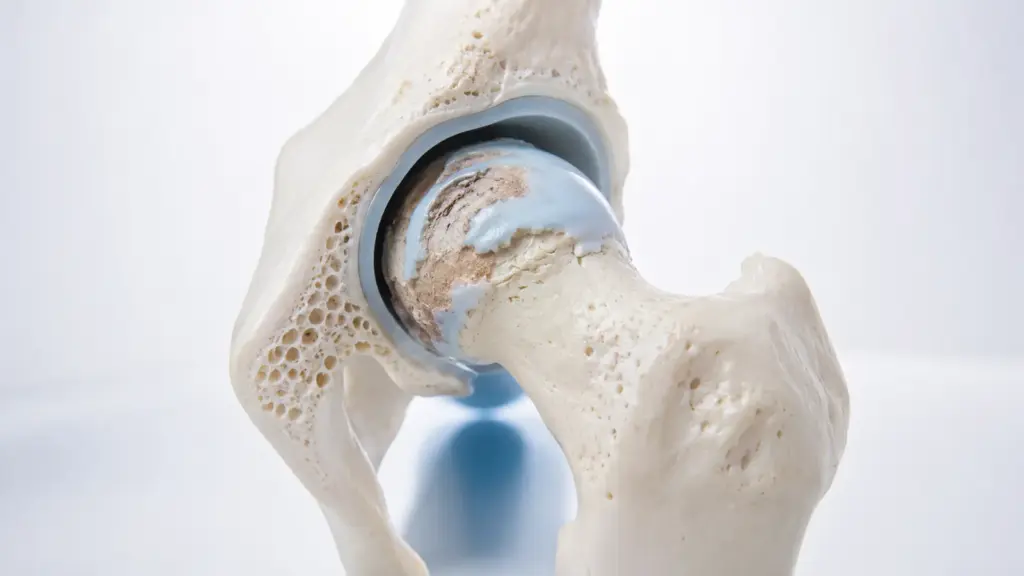
Hip osteoarthritis (coxarthrosis) is a progressive joint disease that results from the gradual thinning and wear of the articular cartilage covering the hip joint. As the cartilage thins, the bone surfaces rub against each other, leading to pain, limited mobility, and, over time, joint deformity.
Osteoarthritis is the most common joint disease worldwide, and the hip is among the most frequently affected joints. Radiographic findings are seen in most individuals aged 65, while this rate reaches approximately 80% in those over 75 (StatPearls, 2026). The disease is classified as “primary” if there is no underlying identifiable cause, and as “secondary” if it develops against a background such as congenital hip dysplasia, a fracture, or avascular necrosis.
The term coxarthrosis (hip osteoarthritis), which is used to describe the same condition, is also frequently encountered in the literature. The answer to the question What is coxarthrosis (hip osteoarthritis)? is essentially this: it is osteoarthritis of the hip joint.
What Causes Hip Osteoarthritis?
Coxarthrosis is not caused by a single factor but rather by a combination of multiple factors. As we age, the cartilage’s ability to repair itself decreases; this is compounded by genetic predisposition, mechanical stress, and structural abnormalities in the joint. It is more common in women than in men.
- Advanced age and female gender
- Excess weight and constant stress on the joint
- Congenital hip dysplasia (a predisposing factor for developmental hip dislocation)
- History of hip fracture or intra-articular injury
- Avascular necrosis of the femoral head
- History of heavy physical labor or repetitive strenuous sports
According to Prof. Dr. Hasan Göçer, in a significant proportion of patients, osteoarthritis is not solely due to aging but stems from undiagnosed hip dysplasia or a past trauma that occurred years earlier; therefore, accurately determining the cause directly influences the treatment plan.
Symptoms of Hip Osteoarthritis
Symptoms of hip osteoarthritis typically begin insidiously and worsen over the years. The most common complaint is hip pain that worsens with movement and improves with rest. The pain is often felt in the groin; from there, it may radiate to the thigh and sometimes down to the knee.
- Pain radiating to the groin, hip, and thigh, which worsens with walking
- Morning stiffness and “start-up pain” after sitting for a long time
- Difficulty with bending movements, such as putting on shoes or socks, or getting in and out of a car
- Decreased walking distance and limping
- In advanced stages, leg shortening and significant limitation of joint movement
Stages of Coxarthrosis
Coxarthrosis is classified from early to advanced stages based on X-ray findings such as narrowing of the joint space, bone spurs (osteophytes), and bone sclerosis (subchondral sclerosis) on X-rays. The narrower the joint space, the more advanced the osteoarthritis is considered to be. Staging is one of the key criteria guiding the decision between conservative treatment and joint replacement surgery.
How Is Hip Osteoarthritis Treated?
Osteoarthritic cartilage does not regenerate on its own; therefore, treatment aims to reduce pain, preserve joint function, and slow the progression of the disease. The answer to the question “What helps with hip osteoarthritis?” varies depending on the stage: while lifestyle changes and physical therapy are the primary approaches in the early stages, surgery may be the only permanent solution in advanced stages.
- Weight control and reducing the load on the joint
- Using a cane on the unaffected side; avoiding long walks on hard surfaces
- Regular, low-impact exercise: swimming, cycling, and water-based exercises
- A physical therapy program to strengthen the hip muscles
These measures can reduce pain and increase walking distance, but they are not expected to completely eliminate symptoms in patients with advanced osteoarthritis detected on X-rays. If symptoms significantly limit daily life, it is necessary to consult a doctor and re-plan treatment.
Hip Osteoarthritis Treatment
Hip osteoarthritis treatment is planned using a stepwise approach. When conservative options fail to control pain or if joint damage is advanced, surgical evaluation is initiated. The table below summarizes the situations in which non-surgical and surgical approaches are preferred.
| Approach | Who is it suitable for? | Goal |
|---|---|---|
| Conservative (non-surgical) | Early–mid-stage patients whose pain does not limit their daily lives | To reduce pain, preserve function, and slow progression |
| Medication | Patients with significant pain and inflammation | Symptom control with pain relievers/anti-inflammatories |
| Surgery (total hip replacement) | Advanced stage, patients who do not respond to conservative treatment | To permanently achieve a pain-free, mobile joint |
Medications play an important role in the treatment of hip osteoarthritis. The general answer to the question “Which medications are effective for hip osteoarthritis?” is those that reduce pain and inflammation; however, their selection, dosage, and duration are individualized and must be determined under a doctor’s supervision. Self-medication based on medication recommendations found online is not appropriate.
“Is physical therapy effective for hip osteoarthritis?” is a frequently asked question: Physical therapy helps reduce pain and maintain mobility by strengthening the muscles around the hip, especially in the early and moderate stages. However, in advanced stages, it does not provide a permanent solution on its own.
Hip Osteoarthritis Surgery
The most common surgical procedure for advanced hip osteoarthritis is total hip replacement, in which the worn-out joint is replaced with an artificial joint. This surgery aims to eliminate the source of pain and restore walking ability and daily function. Hip replacement surgeryis one of the most successful and commonly performed procedures in orthopedics today.
Modern prostheses have high long-term durability. According to combined international registry data, the survival rate of total hip replacements is approximately 89% at 15 years and averages 58% at 25 years (Lancet, 2019). In patients under 65 years of age, 8-year implant survival rates as high as 99% have been reported (AAOS / American Joint Replacement Registry data, 2023).
Clinical Assessment by Prof. Dr. Hasan Göçer
“In my clinical practice, I see that most patients with hip osteoarthritis delay treatment for years, mistaking the pain for a herniated disc. However, pain that radiates to the groin and worsens with walking is most often caused by the hip joint itself. When proper staging is performed, the majority of patients can find long-term relief with conservative treatment without the need for surgery; the decision to operate is based not on X-ray findings, but on how much the patient’s daily life is restricted.”
Prof. Dr. Hasan Göçer — Specialist in Orthopedics and Traumatology
This observation has significant practical importance: accurately identifying the source of pain prevents unnecessary lower back treatments and ensures the patient receives appropriate treatment sooner. Prof. Dr. Göçer emphasizes that in clinical practice, treatment decisions should not be based on a single X-ray but should be evaluated in conjunction with the patient’s walking distance, nighttime pain, and quality of life.
From Diagnosis to Recovery: How Does the Process Proceed?
| Stage | Time | What Happens? |
|---|---|---|
| Initial Examination | Day 1 | Physical examination, pain history, and joint range of motion are assessed; a hip X-ray is ordered |
| Diagnostic Tests & Planning | Weeks 1–2 | Staging is performed using X-rays (or MRI if necessary); a conservative or surgical treatment plan is developed |
| Surgery (if necessary) | Scheduled day | Total hip replacement is performed under general or spinal anesthesia; the procedure typically lasts 1–2 hours |
| Hospital Stay | Days 2–4 | Early mobilization, pain management, and physical therapy to help the patient get back on their feet; discharge is planned |
| Recovery | Weeks 6–12 | Gradual walking, lifting of restrictions, and follow-up visits |
Initial Examination: The physician conducts a detailed interview regarding the location of the pain, how long it has persisted, and which movements exacerbate it; hip range of motion is assessed manually. At this stage, a hip X-ray forms the basis of the diagnosis.
Evaluation and Planning: The stage of osteoarthritis is determined based on the imaging results. While treatment in the early stages is planned without surgery, surgical options are discussed in advanced stages and in cases of pain that limits daily life.
Surgery and Hospital Stay: Patients who receive a prosthesis are typically helped to stand with the assistance of a physical therapist on the first day after surgery. The length of the hospital stay varies depending on the patient’s overall condition.
Recovery: Return to work and daily life depends on the physical demands of the job and the rate of recovery. Follow-up appointments are important for monitoring the condition of the prosthesis and the surrounding joint.
Frequently Asked Questions
What helps with hip osteoarthritis?
Weight control, low-impact exercise (swimming, cycling), physical therapy to strengthen the muscles around the hip, and reducing the load on the joint are the most helpful approaches in the early to moderate stages. If pain is significant, medication is added under a doctor’s supervision. In the advanced stage, these measures may alleviate pain but cannot reverse cartilage damage; in such cases, surgical evaluation is necessary.
Which medications are effective for hip osteoarthritis?
Medications that reduce pain and inflammation are the most commonly used group. However, the type of medication, dosage, and duration of use vary depending on the person’s age, other medical conditions, and the stage of osteoarthritis. For this reason, medication selection must always be made by a doctor; over-the-counter use should be avoided.
Is physical therapy effective for hip osteoarthritis?
Yes, especially in the early and moderate stages, physical therapy helps reduce pain and preserve joint mobility. Strengthening the muscles around the hip helps balance the load on the joint. In advanced stages, however, physical therapy alone does not provide a permanent solution; it is used in conjunction with surgery to speed up post-operative recovery.
What should people with hip osteoarthritis be mindful of?
Avoiding excess weight, limiting long walks on hard surfaces and carrying heavy loads, using a cane on the opposite side, and performing regular low-impact exercises help protect the joint. It is also important to avoid staying in the same position for long periods and to rest when pain increases. According to Prof. Dr. Hasan Göçer, it is crucial for patients to maintain regular, low-impact activity that does not strain the joint rather than remaining sedentary, as this is key to preserving joint function in the long term.
Where does hip osteoarthritis pain occur?
The pain is most commonly felt in the groin and radiates from there to the front-inner side of the thigh, sometimes extending down to the knee. Some patients may also experience pain in the outer and rear regions of the hip. The fact that the pain radiates to the knee can sometimes delay the recognition that the osteoarthritis originates in the hip.
Is hip osteoarthritis dangerous?
Hip osteoarthritis is not a life-threatening condition; however, if left untreated, the pain and limited mobility can progress, significantly reducing the ability to walk and lowering quality of life. Early diagnosis and appropriate treatment can slow this progression. It is important to see a doctor when symptoms begin to affect daily life.
Which doctor should you see for hip osteoarthritis?
Hip osteoarthritis is a condition evaluated by an orthopedic and trauma specialist. It is appropriate to see an orthopedic specialist for symptoms such as groin and hip pain, stiffness that worsens with walking, or limping. The diagnosis is made through a physical examination and X-rays, and a personalized treatment plan is developed.
Conclusion
In this article, we discussed how hip osteoarthritis (coxarthrosis) develops, its symptoms, stages, and treatment options ranging from non-surgical to surgical interventions. Early diagnosis and accurate staging allow most patients to find relief with conservative treatment for an extended period, while hip replacement surgery may offer a permanent solution in advanced stages.
You can begin the examination process to assess your personal situation regarding hip osteoarthritis. Prof. Dr. Hasan Göçer evaluates each patient’s clinical presentation individually to determine the most appropriate treatment options.
References
- Aboulenain S, Brent LH, Saber AY. Primary Osteoarthritis. StatPearls, NIH/NCBI Bookshelf, 2026 — https://www.ncbi.nlm.nih.gov/books/NBK557808/
- Evans JT et al. How long does a hip replacement last? A systematic review and meta-analysis. The Lancet, 2019 — https://www.thelancet.com/journals/lancet/article/PIIS0140-6736(18)31859-2/fulltext
- NLM MeSH — Osteoarthritis, Hip (Coxarthrosis), D015207 — https://meshb.nlm.nih.gov/record/ui?ui=D015207