🦴 Quick Facts from Prof. Dr. Göçer
- Malignant bone tumors are rare; primary cancers originating in bone account for less than 1% of all cancers.
- The most common type is osteosarcoma, which primarily affects children, adolescents, and young adults.
- According to data from the American Cancer Society, the 5-year survival rate for localized (non-metastatic) osteosarcoma ranges from 60% to 75%.
- Standard treatment generally involves a combination of chemotherapy and surgery; limb-sparing surgery is performed in appropriate cases.
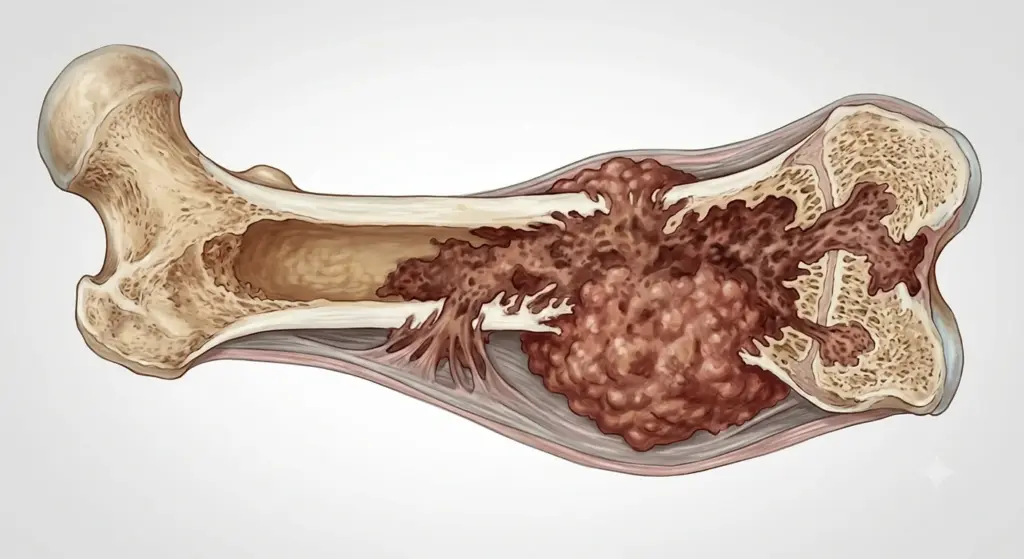
Although most bone masses are benign, a small proportion are cancerous. A malignant bone tumor is a type of cancer in which cells in the bone tissue multiply uncontrollably, invading surrounding tissues and potentially spreading to distant organs. Early diagnosis directly impacts treatment success.
What Is a Malignant Bone Tumor?
A malignant bone tumor occurs when the cells that make up bone multiply abnormally and uncontrollably, forming cancer. Unlike benign tumors, these masses have irregular borders, can grow rapidly, and can spread through the bloodstream to other organs (most commonly the lungs).
If these tumors originate in the bone, they are called primary; if they result from cancer in another organ spreading to the bone, they are called metastatic. The majority of bone cancers seen in adults are actually metastatic; primary cancers originating in the bone are quite rare.
Symptoms of Malignant Bone Tumors
Symptoms vary depending on the tumor’s location, size, and type. In the early stages, symptoms may be mild and could be attributed to overexertion. The following symptoms require evaluation by a physician:
- Persistent bone pain: Pain that worsens over time, does not subside with rest, and wakes you up at night is the most notable symptom.
- Swelling and a palpable mass: A swelling that grows over time in the area of pain may be noticeable.
- Pathological fracture: A bone weakened by cancer may fracture from a minor impact or spontaneously.
- Limited mobility: Tumors near a joint can make movement painful and restricted.
- General symptoms: Unintentional weight loss, constant fatigue, and occasional fever may occur.
According to Prof. Dr. Hasan Göçer, bone pain in young people that has persisted for several weeks, is gradually worsening, and is particularly noticeable at night should not be dismissed as a simple sports injury; in such cases, evaluation via imaging is crucial for early diagnosis.
How Is a Malignant Bone Tumor Diagnosed?
The diagnosis of a malignant tumor is made through a multi-step evaluation. While imaging methods provide strong clues, a definitive diagnosis is possible only through a biopsy.
- Physical examination: The nature of the pain, swelling, and limited mobility are assessed.
- X-ray: This is the first-line imaging modality; it may reveal irregular bone destruction.
- MRI and CT: These provide detailed information on the tumor’s boundaries and its spread to soft tissues and adjacent structures.
- Bone scan / PET-CT: Assesses whether the cancer has spread to other areas (staging).
- Biopsy: A definitive diagnosis is made through pathological examination of a tissue sample taken from the tumor.
Obtaining a biopsy using the correct technique and from the correct site is critical for both the accuracy of the diagnosis and subsequent surgical planning. For this reason, it is recommended that the biopsy and treatment be planned holistically by a team with experience in orthopedic oncology.
Types of Malignant Bone Tumors
The main types of malignant tumors originating in bone and their general characteristics are summarized in the table below. This information provides a general overview; each patient’s condition is evaluated individually.
| Type | Common Age Range | Typical Location | General Notes |
|---|---|---|---|
| Osteosarcoma | Children, adolescents, young adults | Around the knee (femur/tibia ends) | The most common primary malignant type |
| Ewing sarcoma | Children and young adults | Pelvis, femur, ribs | Sensitive to chemotherapy |
| Chondrosarcoma | Typically in individuals over 40 years of age | Pelvis, femur, shoulder | Cartilage-derived; may have a slow course |
Among these types, osteosarcoma is the most common and accounts for approximately one-fifth of all malignant bone tumors. Accurate identification of the type directly shapes the treatment plan; for example, while Ewing sarcoma responds well to chemotherapy, surgery may be the primary treatment for chondrosarcoma.
Clinical Assessment by Prof. Dr. Hasan Göçer
“In my clinical practice, I have observed that the most important factor determining the outcome in malignant bone tumors is the stage at which the diagnosis is made. In patients diagnosed while the tumor is still confined to the bone, both treatment success and the chance of limb preservation increase significantly.”
Prof. Dr. Hasan Göçer — Orthopedic and Traumatology Specialist
This observation has great practical significance. While limb-sparing surgery is often feasible for tumors detected at an early stage, treatment becomes more extensive in cases where diagnosis is delayed. Therefore, not ignoring persistent bone pain is a critical step that can alter the course of the tumor.
Treatment of Malignant Bone Tumors
Treatment is is planned on an individual basis according to the tumor’s type, stage, location, and the patient’s overall condition. In most cases, multiple methods are used in combination, and the decision is made through a collaborative evaluation by different disciplines (orthopedic oncology, medical oncology, radiation oncology).
Surgery
Removal of the tumor along with a margin of healthy tissue is the cornerstone of treatment. In the modern approach, the goal is to completely remove the tumor while preserving the limb (limb-sparing surgery). The excised bone area is reconstructed using a tumor prosthesis or bone graft.
Chemotherapy
For types such as osteosarcoma and Ewing sarcoma, chemotherapy can be administered before (neoadjuvant) and after surgery. Preoperative chemotherapy can shrink the tumor, making limb-sparing surgery easier.
Radiation Therapy
In some types of tumors, particularly in areas where surgery is difficult or to target residual cells, radiation therapy is added to the treatment. Ewing sarcoma is one of the types that is relatively sensitive to radiation therapy.
Prof. Dr. Göçer emphasizes that treatment success in clinical practice depends not only on surgery but also on the proper timing and combination of chemotherapy and, when necessary, radiation therapy. Limb-sparing surgery is an important option for preserving both function and quality of life in suitable patients.
About Survival and Prognosis
The prognosis for malignant bone tumors depends largely on the type of tumor and its stage at the time of diagnosis. According to data from the American Cancer Society, while the 5-year survival rate for localized osteosarcoma ranges from 60% to 75%, this rate drops significantly in cases where the cancer has spread to distant organs (metastatic) at the time of diagnosis.
These figures are averages derived from the general population and do not directly predict the outcome for any single individual. The type of tumor, response to treatment, and early diagnosis are the primary factors influencing an individual’s course of the disease.
From Diagnosis to Recovery: How Does the Process Unfold?
| Stage | Time | What Happens? |
|---|---|---|
| Initial Examination | Day 1 | Physical examination; duration of symptoms is assessed; X-ray is ordered |
| Imaging & Staging | Weeks 1–2 | Tumor boundaries and spread are assessed using MRI/CT and PET |
| Biopsy & Diagnosis | Weeks 2–3 | Tissue sample is examined pathologically to determine the tumor type and grade |
| Treatment | Depending on the type and stage | Chemotherapy, surgery, and, if necessary, radiation therapy are planned |
| Follow-up | Long-term | Regular checkups are conducted to monitor for recurrence and side effects |
Initial Examination and Imaging: The duration and nature of symptoms are assessed; following an X-ray, MRI, CT, and, when necessary, PET scans are used to determine the tumor’s boundaries and extent.
Biopsy and Diagnosis: The tumor type and grade are confirmed by examining the tissue sample. This result forms the basis of the treatment plan.
Treatment and Follow-Up: Depending on the type and stage, chemotherapy, surgery, and radiation therapy are used. Long-term follow-up is conducted after treatment to detect recurrence early.
Frequently Asked Questions
What happens if the tumor is malignant?
A malignant tumor is a type of cancer that can spread to surrounding tissues and distant organs. For this reason, in most cases, chemotherapy, surgery, and, when necessary, radiation therapy are used in combination. Early diagnosis increases the chances of successful treatment and limb preservation.
How is a malignant bone tumor diagnosed?
The diagnosis is made through a physical examination, imaging studies such as X-rays, MRI, and CT scans, and a biopsy for a definitive result. Persistent bone pain that worsens at night, swelling, or an unexpected fracture are warning signs that require evaluation.
Does a malignant bone tumor cause pain?
Yes, pain is the most common symptom. Pain that worsens over time, does not subside with rest, and becomes more pronounced at night is typical. The pain is often accompanied by swelling in the affected area.
Can a malignant bone tumor be fatal?
The prognosis depends on the type of tumor and its stage at the time of diagnosis. Treatment success rates are high in cases detected at an early stage; according to data from the American Cancer Society, the 5-year survival rate for localized osteosarcoma is 60–75%. In advanced cases, this rate decreases, but treatment is still possible.
Can a malignant bone tumor be cured?
Many patients, especially those diagnosed early and whose tumors are confined to the bone, can be cured with appropriate treatment. Generally, it is reported that approximately 60–70% of osteosarcoma patients are cured with treatment. The outcome varies depending on the subtype and response to treatment.
Conclusion
Although malignant bone tumors are rare, their prognosis can be significantly improved with early diagnosis and appropriate treatment. Symptoms such as persistent bone pain, swelling, or unexpected fractures should not be ignored; a diagnosis established through proper imaging and biopsy forms the foundation of treatment success. In modern orthopedic oncology, limb-sparing surgery can preserve both function and quality of life in appropriate cases.
You can begin the examination process to assess your personal situation regarding malignant bone tumors. Prof. Dr. Hasan Göçer evaluates each patient’s clinical presentation individually to determine the most appropriate treatment options.
Sources
- American Cancer Society, “Survival Rates for Osteosarcoma,” 2024 — https://www.cancer.org/cancer/types/osteosarcoma/detection-diagnosis-staging/survival-rates.html
- StatPearls / NCBI Bookshelf, “Osteosarcoma (Osteogenic Sarcoma)”, 2024 — https://www.ncbi.nlm.nih.gov/books/NBK563177/
- Papakonstantinou E. et al., Journal of Bone Oncology, 2020 — “Limb-salvage surgery … in limb osteosarcoma” — https://www.ncbi.nlm.nih.gov/pmc/articles/PMC7567946/