🦴 Quick Facts from Prof. Dr. Göçer
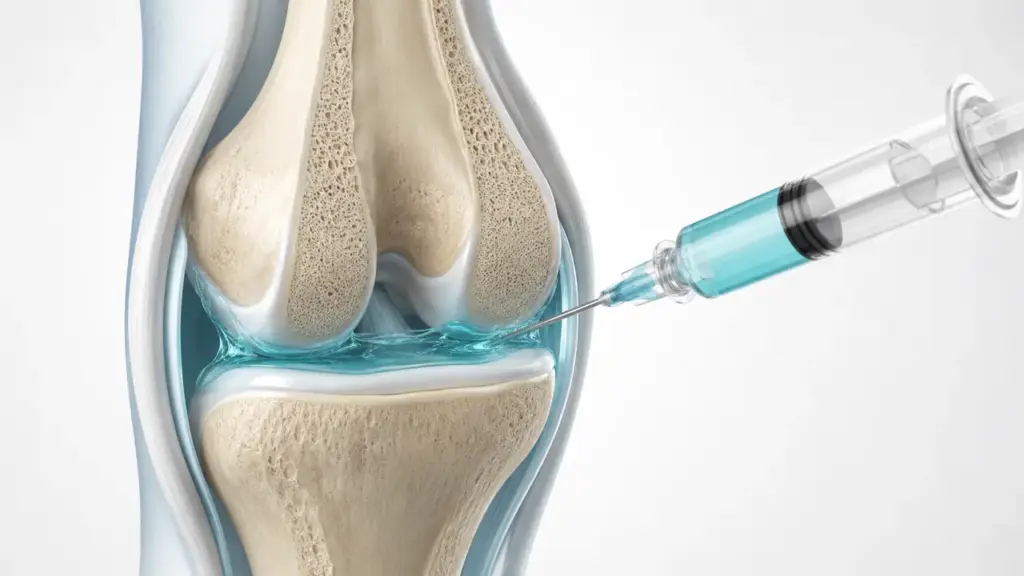
- Although the term “prosthesis” appears in its name, a liquid knee prosthesis is not actually a surgical procedure; it is a hydrogel injection administered into the joint.
- The most common type is a non-absorbable gel consisting of approximately 97.5% water and 2.5% polyacrylamide.
- The gel integrates with the joint fluid to form a lubricating and cushioning layer; it is designed to reduce pain and stiffness.
- Studies have reported improvements in pain and function lasting from 6 months to 3 years with a single application.
Non-surgical options for knee osteoarthritis are becoming increasingly diverse. The “liquid knee replacement”, though commonly known by this name, is not actually a surgical prosthesis; it is a specialized hydrogel treatment injected into the joint. The goal is to to reduce pain and facilitate movement by creating a lubricating and cushioning layer in the worn joint.
What Is a Liquid Knee Replacement (Hydrogel)?
A liquid knee replacement is the application of a hydrogel (a gel-like substance) injected into the knee joint. The term “prosthesis” is a metaphor used because the gel serves a cushioning and lubricating function within the joint; however, the procedure does not involve the surgical implantation of a prosthesis. The most common type is a non-absorbable (permanent) gel consisting of approximately 97.5% water and 2.5% polyacrylamide.
Once injected, the gel integrates with the synovial membrane tissue to form a durable, lubricating layer within the joint. This layer is designed to facilitate joint movement and reduce pain and stiffness. Unlike traditional hyaluronic acid injections, it breaks down more slowly in the body, allowing its effects to last longer.
How Is a Liquid Knee Replacement Administered?
The liquid knee replacement procedure is not a surgical procedure but an injection that can be performed in an outpatient setting. The general steps are as follows:
- Evaluation: The condition of the knee is assessed through examination and imaging to determine suitability.
- Preparation: The injection site is cleaned; some procedures may be performed under ultrasound guidance.
- Injection: The hydrogel is injected into the joint in the appropriate amount.
- Observation: After a brief observation period, the patient can usually return to their daily activities the same day.
The procedure is usually brief and does not require surgery. While a single injection may be sufficient for some products, multiple sessions may be scheduled for other applications based on the physician’s recommendation. It is important that the injection be performed using the proper technique and under sterile conditions.
Who Is a Candidate for a Liquid Knee Replacement?
Liquid knee replacement is typically considered for patients experiencing pain due to knee osteoarthritis who are exploring non-surgical options. Eligibility is determined by a physician’s evaluation; generally, it may be considered in the following situations:
- Moderate osteoarthritis: Osteoarthritis that causes symptoms but does not yet require surgery.
- Patients who have not benefited from other injections: Patients who have not derived sufficient benefit from treatments such as hyaluronic acid.
- Those who wish to postpone surgery: Patients who are not yet candidates for a prosthesis or who do not wish to undergo surgery.
- Those who are not suitable candidates for surgery: Individuals for whom surgery is risky due to other health issues.
According to Prof. Dr. Hasan Göçer, a liquid knee prosthesis is not a substitute for surgery in advanced osteoarthritis; however, in suitable patients, it can help manage the condition without surgery by reducing pain. For this reason, it is important to evaluate this treatment—along with basic methods such as exercise and weight control—with realistic expectations.
The Difference Between Liquid Knee Prostheses and Other Injections
Different types of injections administered into the knee vary in terms of their mechanism of action and duration of effect. The table below provides a general comparison; the appropriate option is determined by a physician’s evaluation.
| Injection | General Characteristics | Duration of Effect |
|---|---|---|
| Corticosteroid | Strong, rapid control of inflammation and pain | Several weeks |
| Hyaluronic acid | Lubricates the joint | Several months |
| Liquid knee prosthesis (hydrogel) | Non-absorbable, permanent gel layer | Months–years (variable) |
The key difference between a liquid knee prosthesis and traditional injections is that the gel is not absorbed by the body and can remain in the joint for a longer period of time. Studies have reported improvements in pain and function lasting from 6 months to 3 years with a single application; however, the response varies from patient to patient, and since this method is relatively new, long-term outcomes continue to be investigated.
Clinical Assessment by Prof. Dr. Hasan Göçer
“In my clinical practice, the aspect I most often explain to patients regarding the liquid knee prosthesis is that, despite its name, it is not a surgical procedure or a permanent ‘prosthesis.’ It is an injection option that can reduce pain in suitable patients; however, it is not a substitute for surgery in cases of advanced osteoarthritis. Having realistic expectations is crucial for patient satisfaction.”
Prof. Dr. Hasan Göçer — Orthopedic and Traumatology Specialist
This information is very important because the term “prosthesis” can create false expectations in some patients. A liquid knee prosthesis does not regenerate cartilage or reverse osteoarthritis; it is a method aimed at alleviating symptoms. The most appropriate approach is to evaluate this procedure as part of a comprehensive plan that includes fundamental treatments such as exercise and weight management.
From Evaluation to Follow-Up: How Does the Process Proceed?
| Stage | Time | What Happens? |
|---|---|---|
| Evaluation | Day 1 | The condition of the joint and the stage of osteoarthritis are assessed, and eligibility is determined |
| Administration | Procedure day | The hydrogel is injected into the joint in an outpatient setting |
| Early Phase | First few days | After a brief observation period, the patient returns to daily life |
| Effect Period | Weeks–months | Gradual improvement in pain and stiffness is assessed |
| Follow-up | Regular | Response is monitored; the overall treatment plan is reviewed |
Evaluation and Application: The condition of the joint and the stage of osteoarthritis are assessed; if appropriate, hydrogel is injected into the joint in an outpatient setting.
Effect and Follow-up: Improvement in pain and stiffness is assessed over weeks to months; the response to treatment is monitored regularly, and the overall plan is reviewed.
Frequently Asked Questions
Is a liquid knee prosthesis a real prosthesis?
No. Despite its name, a liquid knee prosthesis is not a surgical prosthesis; it is a hydrogel injection administered into the joint. The term “prosthesis” is a metaphor used because the gel acts as a cushion and lubricant within the joint. The procedure does not require surgery.
How long does the effect of a liquid knee prosthesis last?
The duration of the effect varies from patient to patient. Studies have reported improvements in pain and function lasting from 6 months to 3 years. Since the gel is not absorbed by the body, its effects may last longer than those of traditional injections; however, the response varies from person to person.
Can a liquid knee prosthesis replace surgery?
In advanced osteoarthritis, a liquid knee prosthesis cannot replace surgery. In suitable patients, it can help manage the condition without surgery by reducing pain and may delay the need for surgery. However, in cases of widespread and advanced osteoarthritis, knee replacement surgery may be necessary. The decision is made based on the physician’s evaluation.
Who is not a candidate for a liquid knee prosthesis?
This procedure may not be suitable for patients with an active joint infection or very advanced osteoarthritis. Eligibility is determined by the physician based on an evaluation of the condition of the knee and the patient’s overall health.
Conclusion
Although the term “prosthesis” appears in its name, the liquid knee prosthesis (hydrogel) is not a surgical procedure; rather, it is a non-surgical injection treatment aimed at reducing pain associated with knee osteoarthritis. The non-absorbable gel can alleviate symptoms by forming a lubricating layer in the joint; its effectiveness varies from patient to patient. While it can be a valuable option for suitable patients, it is not a substitute for surgery in cases of advanced osteoarthritis and should be evaluated within a comprehensive treatment plan with realistic expectations.
You can begin the consultation process to evaluate your personal situation regarding liquid knee replacement. Prof. Dr. Hasan Göçer evaluates appropriate treatment options by addressing each patient’s clinical presentation individually.
References
- The Knee (Elsevier), “Efficacy of novel polyacrylamide hydrogel injection for osteoarthritis,” 2026 — https://www.thekneejournal.com/article/S0968-0160(26)00172-9/fulltext
- NCBI/PMC, “Effectiveness and safety of polyacrylamide hydrogel injection for knee osteoarthritis: 12-month follow-up,” 2024 — https://www.ncbi.nlm.nih.gov/pmc/articles/PMC11064315/
- Osteoarthritis and Cartilage (OARSI), “Polyacrylamide hydrogel injection for knee osteoarthritis: 52-week prospective study,” 2021 — https://www.oarsijournal.com/article/S1063-4584(21)00403-9/fulltext