🦴 Quick Facts from Prof. Dr. Göçer
- High tibial osteotomy (HTO) is a joint-preserving surgery that corrects the leg axis and shifts the load on the knee from the damaged compartment to the healthy one.
- The ideal candidate is typically a patient under 60 years of age who is active and has isolated medial compartment osteoarthritis and an “O-leg” (varus) alignment.
- The goal is to reduce pain, slow cartilage wear, and delay or postpone the need for a knee replacement.
- According to the literature, more than 80% of patients return to their normal daily lives one year after surgery.
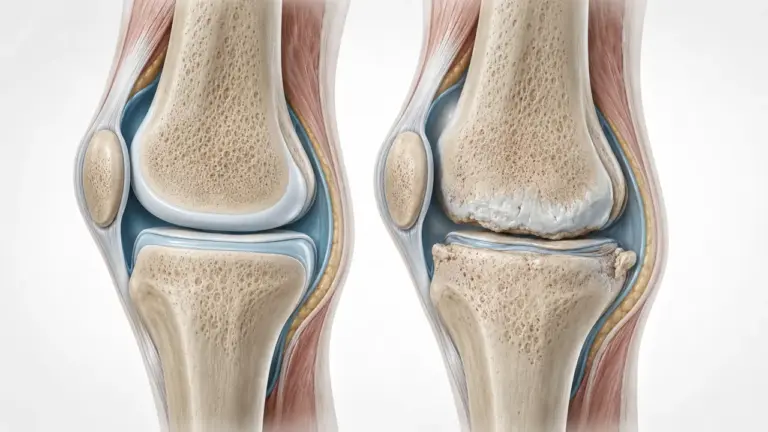
Knee osteoarthritis does not always require a knee replacement; in some patients, the main problem is that a misalignment in the leg axis causes an uneven load on the knee.High tibial osteotomy is a joint-preserving surgical procedure in which the upper part of the tibia (tibia) to correct the leg axis and rebalance the load on the knee.
What Is High Tibial Osteotomy (HTO)?
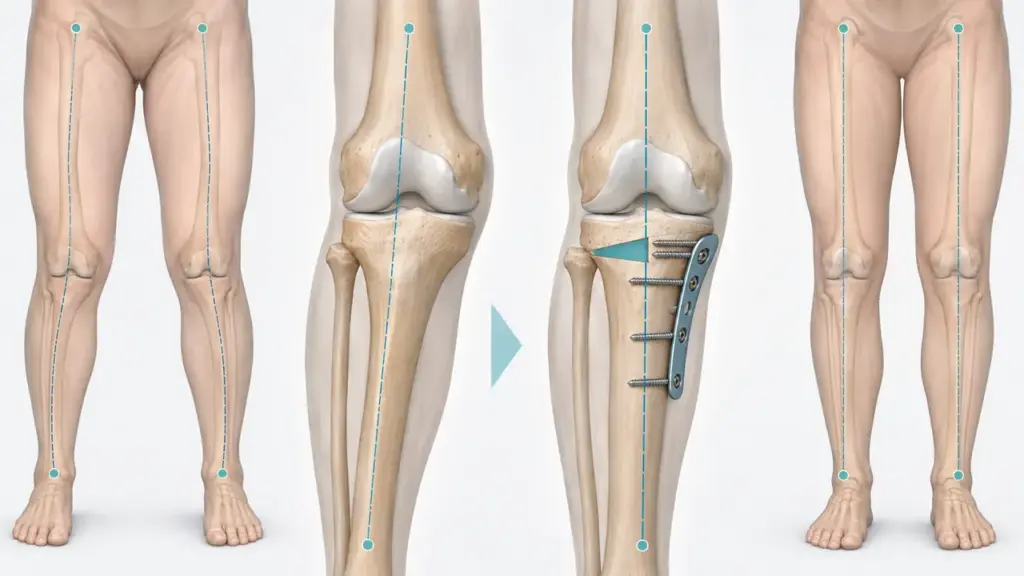
High tibial osteotomy is a surgical procedure in which the leg axis is realigned through a controlled bone cut in the upper (high) portion of the tibia. “Osteotomy” refers to the planned cutting and reshaping of bone. The goal is to shift the load to the healthy portion of the knee by moving the knee’s mechanical axis away from the damaged area.
Particularly in “bowleg” (varus) alignment, body weight bears down on the inner compartment of the knee, accelerating cartilage wear in that area. When the axis is corrected slightly toward the “X-leg” (valgus) position with HTO, the load on the medial compartment decreases. This reduces pain, slows cartilage wear, and may delay the need for a knee replacement.
Who Is a Candidate for High Tibial Osteotomy (HTO)? (Indications)
The indications for high tibial osteotomy depend on proper patient selection; because the success of this method largely depends on identifying the appropriate candidate. The ideal candidate generally has the following characteristics:
- Young and active patients: Typically individuals under 60 years of age who lead an active lifestyle.
- Isolated medial compartment osteoarthritis: Wear and tear limited to only the inner (medial) compartment of the knee.
- Varus (bow-legged) alignment: A deviation of the leg axis inward.
- Healthy adjacent compartments: The lateral and patellar compartments are largely healthy.
- Appropriate general condition: The patient is not overweight and has sufficient range of motion in the knee.
According to Prof. Dr. Hasan Göçer, high tibial osteotomy is a valuable option, particularly for young and active patients for whom knee replacement is still premature; it allows the patient to maintain an active lifestyle while preserving their own joint and can delay the need for a knee replacement for many years.
HTO is generally not appropriate for patients with inflammatory joint disease, widespread osteoarthritis affecting multiple compartments of the knee, severe loss of range of motion, or significant ligament instability. In these cases, other treatment options are considered.
How Is High Tibial Osteotomy (HTO) Surgery Performed?
High tibial osteotomy surgery is performed under general or regional anesthesia. Prior to surgery, the angle to be corrected is planned in detail. The most commonly used method is the “open wedge” (medial open wedge) technique performed from the inner side. The general steps are as follows:
- Planning: The angle to be corrected is calculated using standing axial X-rays.
- Anesthesia: The appropriate anesthesia method is administered to the patient.
- Bone cut: A controlled cut is made in the upper part of the tibia.
- Axial Correction: The bone is realigned according to the planned angle (in the open wedge technique, a gap is created).
- Fixation: The corrected bone is stabilized with plates and screws; if necessary, the space is supported with a bone graft.
The most critical stage of the surgery is the accurate calculation of the angle to be corrected, as the success of the procedure depends on properly aligning the axis to a neutral or mild valgus position. Therefore, preoperative planning is of great importance.
Clinical Assessment by Prof. Dr. Hasan Göçer
“In my clinical practice, I emphasize that high tibial osteotomy holds a special place because it offers young and active patients the opportunity to ‘preserve their own joint.’ When performed on the right patient with the correct angle, this surgery both reduces pain and can delay the need for a prosthesis for years. The key to success lies in patient selection and meticulous planning.”
Prof. Dr. Hasan Göçer — Orthopedic and Traumatology Specialist
The importance of this approach stems from the fact that YTO is a “joint-preserving” surgery. While a prosthesis replaces the damaged joint with an artificial surface, osteotomy rebalances the load by preserving the patient’s own joint. In this regard, it offers the possibility of postponing the need for a prosthesis until a later age, particularly in younger patients.
Post-High Tibial Osteotomy (HTO) Surgery
Recovery after high tibial osteotomy surgery follows a specific process because the bone must heal. Weight-bearing is generally increased gradually in the early stages and is accompanied by physical therapy.
- Early phase (first weeks): Typically involves partial weight-bearing and the use of crutches; range-of-motion exercises.
- Bone union phase: Bone healing is monitored; weight-bearing is gradually increased.
- First months: Gradual return to daily activities with exercises to increase muscle strength.
- Later stage: According to the literature, more than 80% of patients return to their normal daily lives within one year.
The recovery period varies depending on the patient’s bone healing rate, the surgical technique used, and adherence to physical therapy. Because bone healing is required, recovery may take longer compared to some prosthetic surgeries. Regular follow-up visits are important for monitoring bone healing.
From Surgery to Recovery: How Does the Process Proceed?
| Stage | Time | What Happens? |
|---|---|---|
| Evaluation & Planning | Pre-surgery | The angle to be corrected is calculated using a standing axial X-ray |
| Surgery | Day of the procedure | The tibia is cut, the axis is corrected, and it is stabilized with a plate and screws |
| Early Recovery | First weeks | Partial weight-bearing and physical therapy begin |
| Bone Union | Weeks–months | Bone union is monitored, and the load is gradually increased |
| Return to Daily Activities & Follow-up | Months | The patient returns to daily activities and is monitored with regular follow-up visits |
Evaluation and Surgery: The angle to be corrected is calculated using an axial X-ray taken while standing; during surgery, the bone is cut, realigned, and stabilized.
Recovery and Bone Union: Partial weight-bearing and physical therapy begin early on; the load is gradually increased as the bone heals.
Return to Daily Activities and Follow-up: Patients gradually return to daily activities; bone union and alignment are monitored through regular follow-up visits.
Frequently Asked Questions
Is YTO surgery risky?
High tibial osteotomy is a procedure with a high success rate and a low complication rate in appropriate patients; the rate of nonunion is quite low in the literature. Although it carries certain risks, like any surgery, these risks are kept low with proper patient selection and meticulous planning.
How long does high tibial osteotomy surgery take?
A high tibial osteotomy (YTO) surgery is typically completed within a few hours. The duration may vary depending on the technique used, the angle to be corrected, and whether any additional procedures are performed. The exact duration is determined based on the surgical plan.
What is the recovery process like after high tibial osteotomy surgery?
Recovery proceeds gradually because the bone needs to heal. Partial weight-bearing and physical therapy are initiated early on; the weight-bearing load is increased as the bone heals. According to the literature, more than 80% of patients return to their normal daily lives within one year. The duration varies depending on the individual and the surgical technique.
High tibial osteotomy or knee replacement?
The two procedures serve different purposes. HTO balances the load by preserving the patient’s own joint in young and active patients and delays the need for a knee replacement; knee replacement, on the other hand, replaces the damaged joint in patients with widespread osteoarthritis. The appropriate option is determined based on the patient’s age, knee alignment, and the extent of osteoarthritis.
Conclusion
High tibial osteotomy (HTO) is a joint-preserving surgery that corrects the leg axis, shifting the load from the damaged compartment to the healthy one. Especially in young, active patients with isolated medial compartment osteoarthritis, it reduces pain while preserving the patient’s own joint and may delay the need for a prosthesis. The key to success lies in proper patient selection and meticulous planning of the correction angle.
You can begin the consultation process to have your personal situation evaluated regarding high tibial osteotomy. Prof. Dr. Hasan Göçer evaluates appropriate treatment options by addressing each patient’s clinical presentation individually.
References
- American Journal of Roentgenology (AJR), “High Tibial Osteotomy: An Update for Radiologists,” 2021 — https://ajronline.org/doi/10.2214/AJR.21.26659
- Annals of Joint, “Indications and Results of High Tibial Osteotomy” (ISAKOS Criteria), 2017 — https://aoj.amegroups.org/article/view/3720/4378
- NCBI/PMC, “High Tibial Osteotomy for Varus Deformity of the Knee,” 2021 — https://www.ncbi.nlm.nih.gov/pmc/articles/PMC8274793/